SEO Report for a Client: What to Put on the One Page
 By Prabhav Lamichhane6 min readPublished
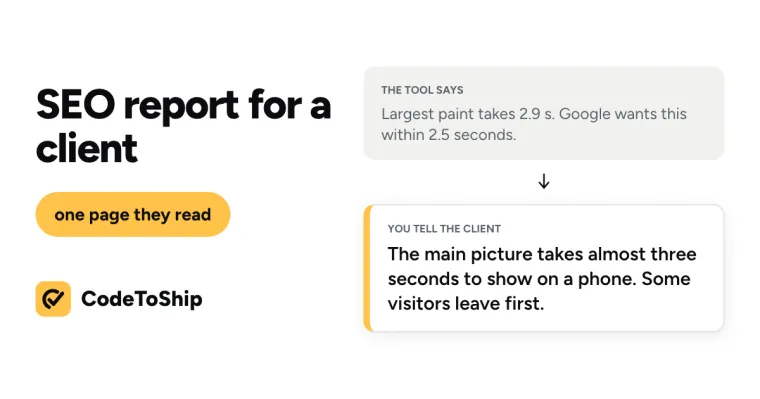
In short: an SEO report for a client is one page. The owner reads it, then asks what it costs. Write the findings in their words, not the tool's. Below are five real ones.
What to do
- Start with the score and one plain sentence, not the list.
- Pick three fixes and write each in the owner's words.
- Send the full list to your developer, not the owner.
Fix first (three). The main picture, two heavy images, a page that jumps.
Already fine. The technical basics.
Next. What we do, in what order, and when you see it.
From you. A yes to the first fixes.
How does one finding read to a client?
The left side is the audit's own text, from our audit of kickoffclock.com on October 27, 2026 (the site belongs to someone on our team). The right side is what we would put on the client's page. Nothing on the right adds a number the audit did not find. The wording on the right is ours, not a rule.
The tool says PF-02
Largest paint takes 2.9 s. The biggest thing on the screen appears late. Google wants this within 2.5 seconds.
You tell the client
The main picture on your home page takes almost three seconds to show up on a phone. Google asks for two and a half. Some visitors leave before they see it.
The tool says IM-03
2 images heavier than they should be. The worst is a content image at 354 KB (over 200 KB).
You tell the client
Two of your pictures are much larger than they need to be, and they slow the page down each time they load. Making them smaller will not change how they look.
The tool says IM-05
6 images without width and height. The browser cannot reserve space before they load, so the page jumps.
You tell the client
Your page shifts around while it loads, so a visitor can tap the wrong thing. It comes from six pictures, and it is a small job to fix.
The tool says CT-03
The writing is hard to read. The Flesch reading score is 41 (60 to 70 is plain English).
You tell the client
Your text is harder to read than most visitors want on a phone. We would shorten the longest paragraphs first. That is also a good place for your own voice.
The tool says PF-01
Mobile performance score is 89 out of 100. Google's lab test of this page on a mid-range phone and a slow connection scored it below 90.
You tell the client
On a mid-range phone and a slow connection, Google scores your page 89 out of 100. That is good, and it is close to the line where we would call it fast.
What goes on the one page?
- The score, and one sentence about it
- Not the list. A number the client can hold on to, with what it means in plain words. In our audit of kickoffclock.com the score was 89 out of 100, graded Good, so the sentence is: your site is in good shape, and a few things are costing you visitors.
- The three things to fix first
- Pick three from the tool's fix-first list, and write each in the client's words, like the five lines above. Three is what a person remembers after one read.
- What is already fine
- Say what works, with one real figure. In the same audit the technical area scored 95 out of 100. The client then knows you looked at the whole site, and it makes the three problems easier to believe.
- What happens next
- In your own words: what you will do, in what order, and when they will see it. Do not promise rankings or visitors. You can promise that the page loads faster, because the next audit will show it.
- One thing you need from them
- Approve the first fixes, send a login, or book a call. One ask, as the last line.
What does the developer get instead?
The audit found 13 things to fix. Nine of them are low severity, and most are for the person who builds the site. Three examples from the same audit, none of which belongs on the client's page:
SE-06The rules for which scripts may run only report, they do not blockSM-09The sitemap uses priority and changefreqOP-31The icon is smaller than Google recommends
Send the full list to the developer, with the fixes. The owner gets the page, and a line at the bottom saying the full list went to the person who will do the work.
Which words should you swap?
A business owner has never heard these. Say what the thing does for them. This list is our advice, not a standard.
| Instead of | Write |
|---|---|
| Largest Contentful Paint | how long the main picture takes to show |
| Crawl and index | Google reads your site and lists it |
| Meta description | the text under your name in Google |
| Structured data | extra details Google can show about you |
| Core Web Vitals | Google's speed and steadiness tests |
Questions about an SEO report for a client
How long should an SEO report for a client be?
One page for the owner, and the full list for whoever builds the site. If the owner needs more than one page to see where they stand, the first page is doing too much.
Do I send a PDF or a link?
A PDF opens everywhere and cannot change after you send it. A link is better when the page is kept up to date. Whichever you choose, put the one-page summary where the client lands first.
What if the score is low?
Say it in the first sentences, with what you are doing about it. Two of the pages we read for this guide say the same: do not make the client look for the bad news.
Does this page cover rankings and traffic?
No. It covers a report made from a site audit. Rankings and visits come from Search Console and analytics and need their own page of the report. For the audit side, the SEO audit report template has the six parts, and the white label SEO report guide shows how to put your own name on it.
Want the findings for your own site?
The free audit checks one page and gives you the score, the counts and the first fixes in the tool's words. Paste any web address, then rewrite the top three for your client.
Not sure how a full report looks? See seven report and pitch deck designs.
Sources and how the example was made (status checked November 2, 2026)
- The audit is our own, of kickoffclock.com, run on October 27, 2026 with Google's speed test. The site belongs to someone on our team. The left side of each row is the audit's own wording; the right side was written for this page.
- Swydo, How to Create an SEO Report That Proves Your Value to Clients (read November 2, 2026): put bad news in the first sentences, and turn jargon into what it means for the client's business.
- SiteGuru, How to Build SEO Reports for Clients (read November 2, 2026): write a report the client can follow without you in the room, and do not hide bad news.
- Reporting Ninja, SEO reports for clients (read November 2, 2026): start with the client's goal, explain what changed, and give one or two next steps.
- All three describe rankings and traffic reports and show no real audit findings in their text. None gave a figure we use.