How to Get Web Design Clients With a Free Audit
 By Prabhav Lamichhane9 min readPublished
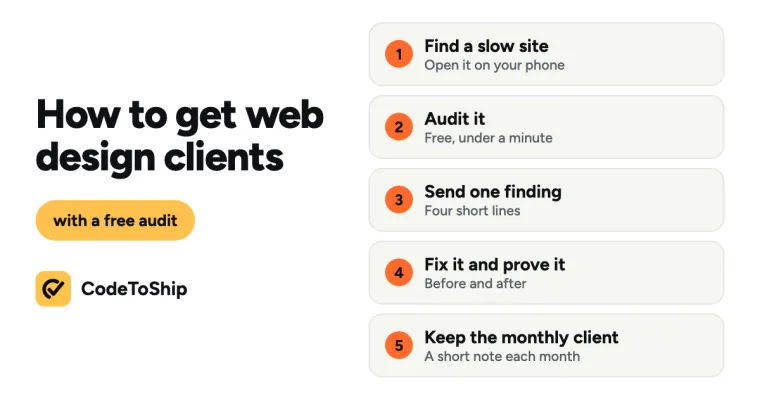
Do not wait for work: run a free audit of a business's site and send the owner one finding in four lines.
Pitch the fix, do it, then send a report with your name on it every month.
For freelancers and small agency owners. No portfolio needed. Try each step on a real site as you read. Selling SEO instead? See how to get SEO clients.
By the end of this page you will have:
- five businesses worth contacting, scored by you
- one real finding for each, from a free audit
- a message ready to send, and the deck to send when they reply
- a plan for turning one fix into a monthly client
Find a business with a site worth fixing
You get: five leads worth a message
The best lead is a business that is open, wants customers and has a site that gets in the way. You do not need a tool to spot one. Open a local shop, clinic or restaurant on your phone and look for the signs below.
Open the prospect's site on your phone. Look for:
- First, the business is open and activeRecent reviews or posts, or a phone that answers
- The main picture is slow to show on a phone
- The text jumps down while the page loads
- It looks cramped or broken on a phone
- The photos look huge, blurry or stretched
- No call, book or order button near the top
- The design or the footer year looks years old
Two or three of these is worth a free audit. This is our rule of thumb, not a measured score. The audit in the next step gives the real numbers.
Run a free audit and pick one finding
You get: one finding an owner can see
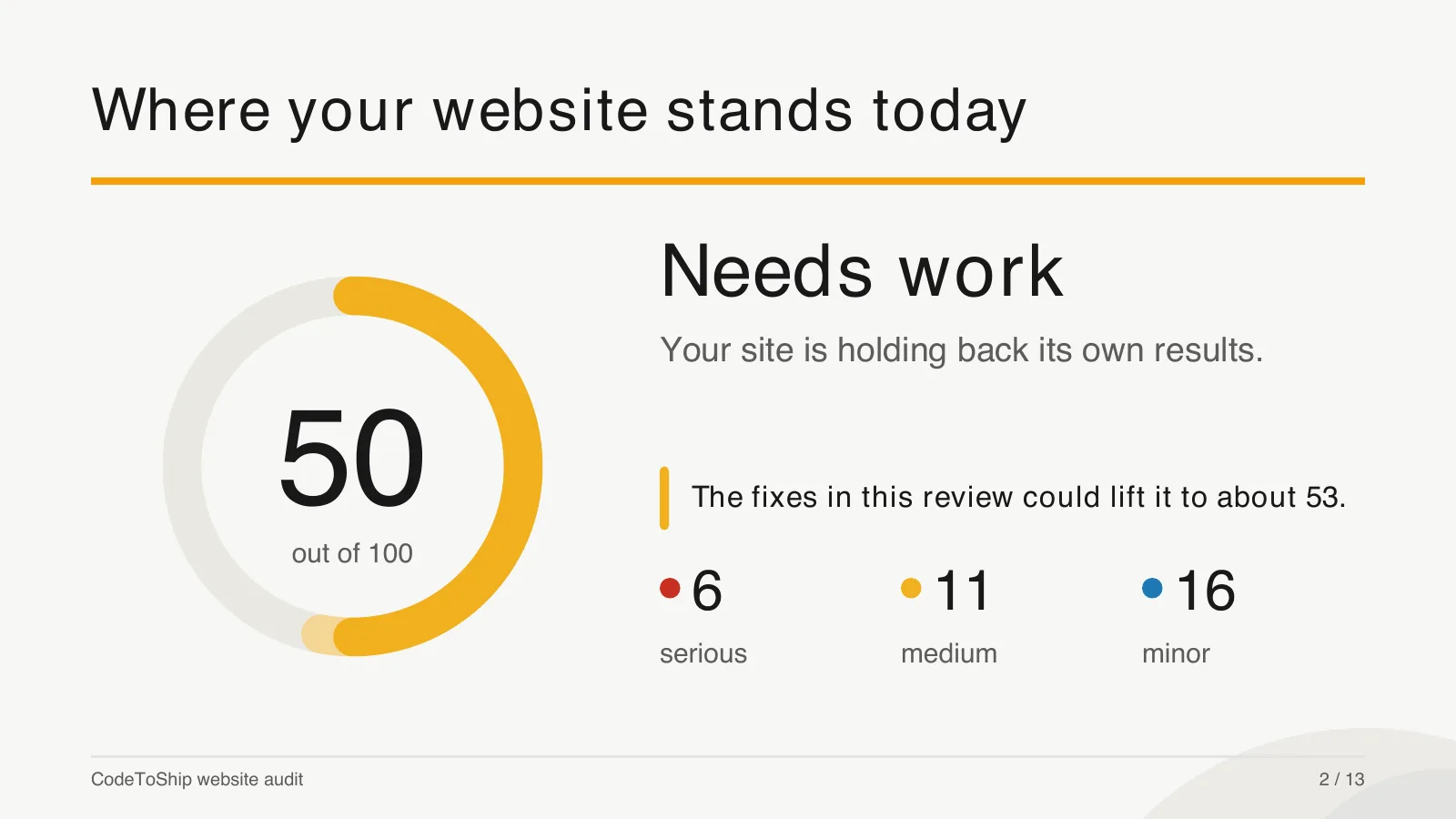
Paste the address into the free audit. It takes under a minute and scores the page out of 100. You will get a list. Do not send the list. Pick the one finding that a business owner can see and understand.
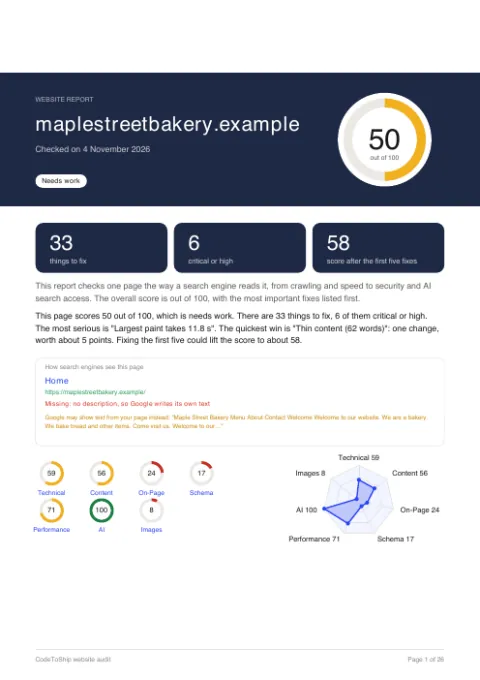
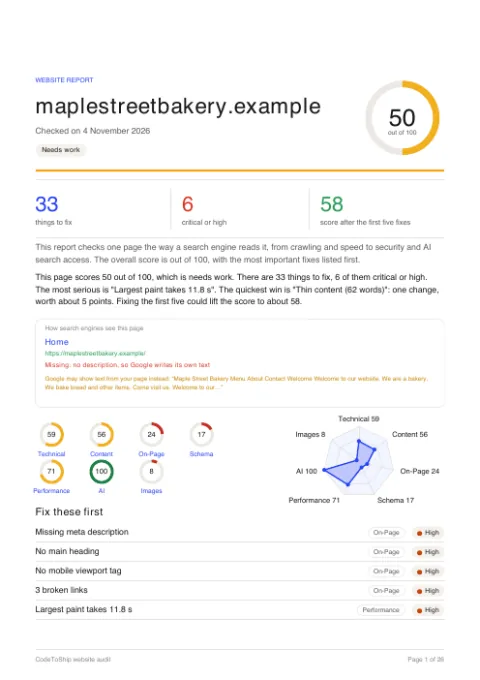
A real example. Our audit of a made-up bakery site scored 50 out of 100, which is needs work. It found 33 things to fix, 6 of them serious. Three an owner can picture:
- Largest paint takes 11.8 s
- Missing meta description
- 4 images heavier than they should be
Maple Street Bakery is a business we invented for our video. We ran our own audit on a careless copy of its site, so the score and the findings are real output, not drawn by hand.
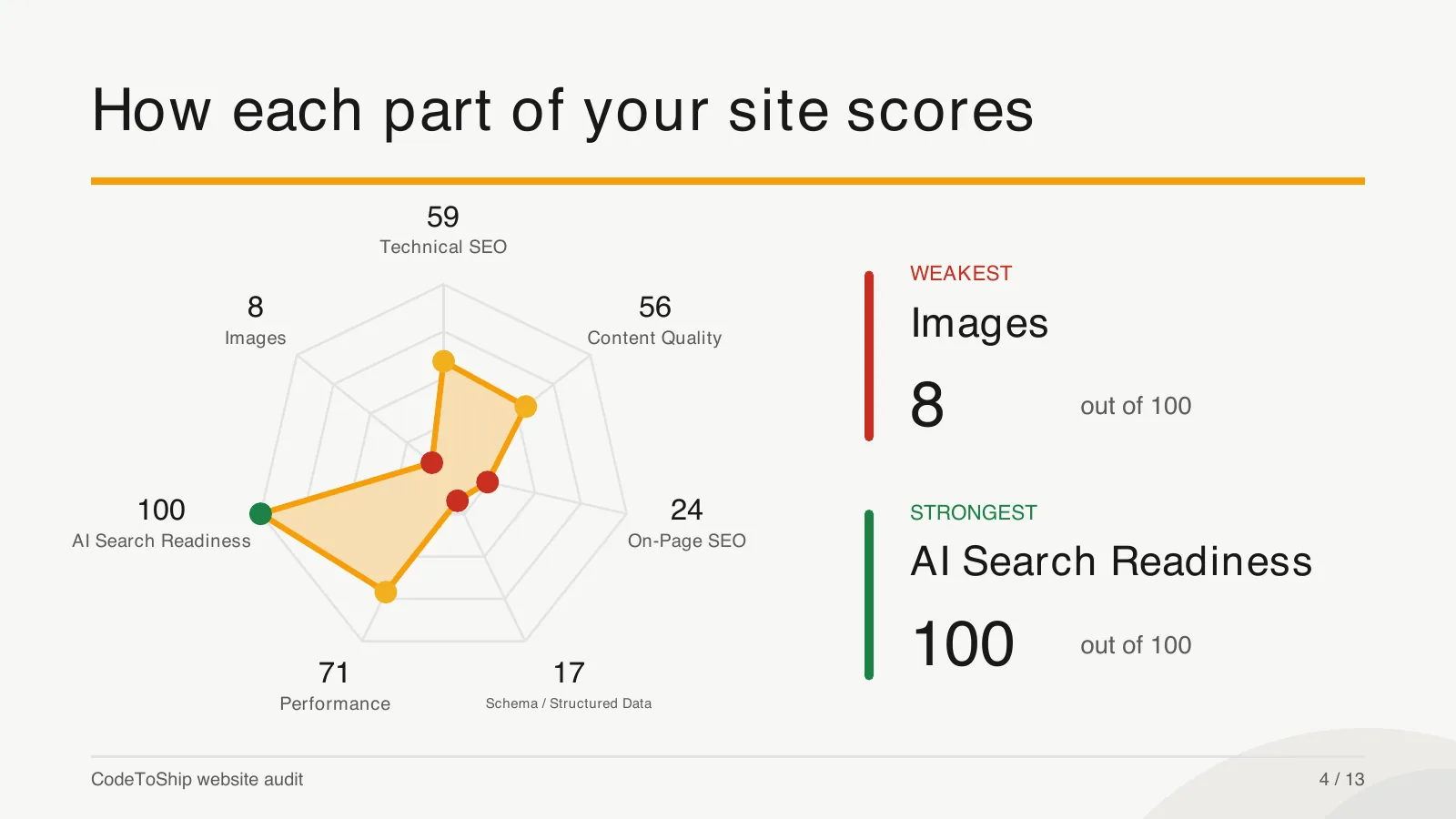
Not sure what the audit checks? The website audit checklist lists the seven areas in order and how to check each by hand.
Send one finding, in four lines
You get: a message ready to send
This is a cold email, but it leads with proof, not with a pitch. A pitch asks for a favor. A finding gives something first. Four short lines: what you found, why it matters, how you would fix it, and an offer to fix it for them. Here is one.
To: owner of Maple Street Bakery
Subject: One thing on your website
Hi there,
I looked at your website on a phone and found one thing.
- What I found: The biggest picture on your page takes 11.8 seconds to show on a phone.
- Why it matters: Google asks for 2.5 seconds or less, and a visitor on a phone waits for that picture.
- How I would fix it: I would resize it, save it in a lighter format and load it first.
- If you want it fixed: Reply and I will send you a price.
Sam
Other findings from the same audit you could lead with
- No Google description: the page has no text under its Google listing.
- Heavy pictures: the biggest is 862 KB.
- Not set up for phones: phones show a shrunken desktop page.
- Text that jumps: the page moves down while it loads.
If the owner replies with a question, answer it in plain words. The SEO report for a client guide shows five findings written the way an owner reads them.
Show the pitch when they reply
You get: a deck that does the explaining
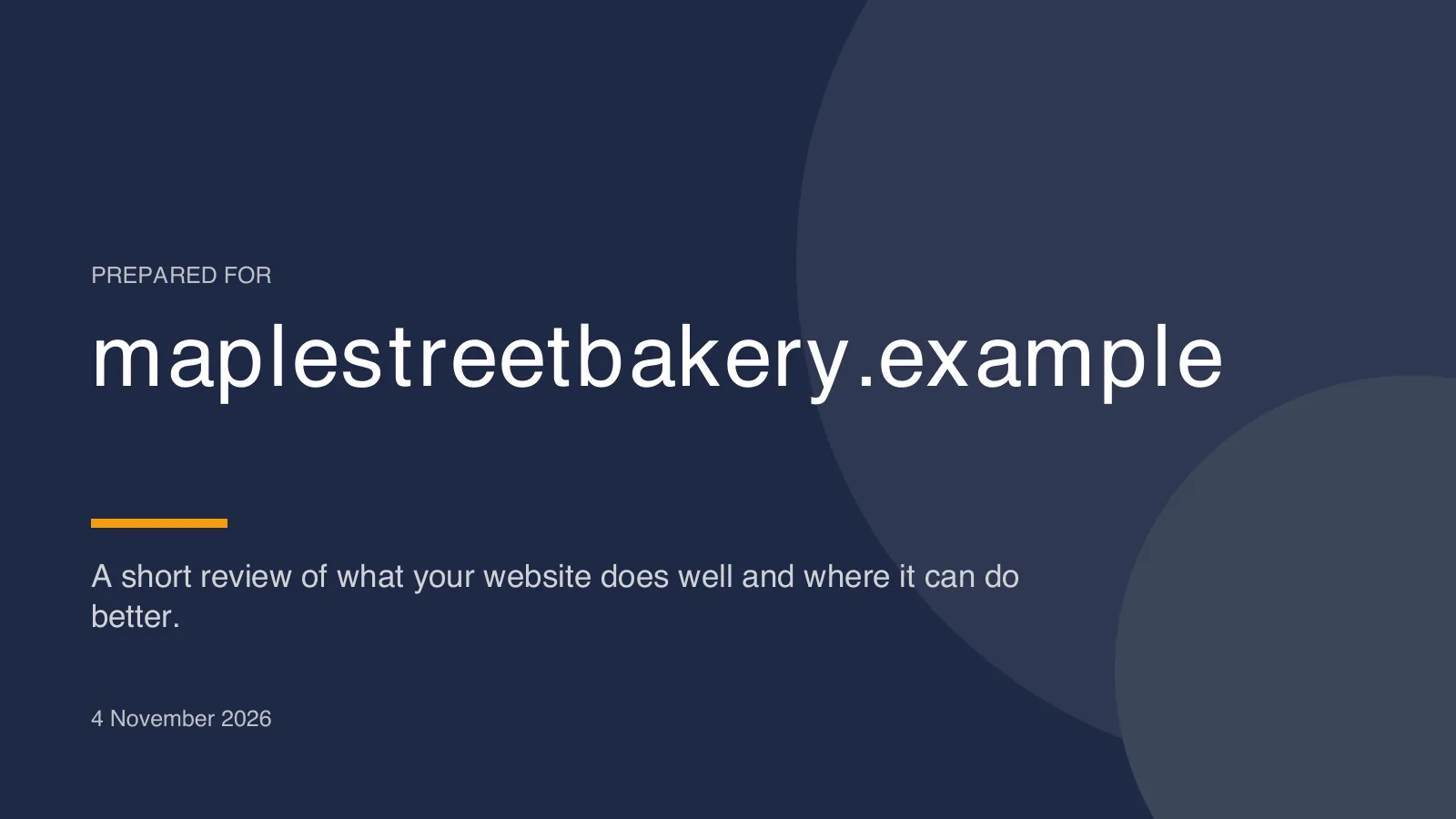
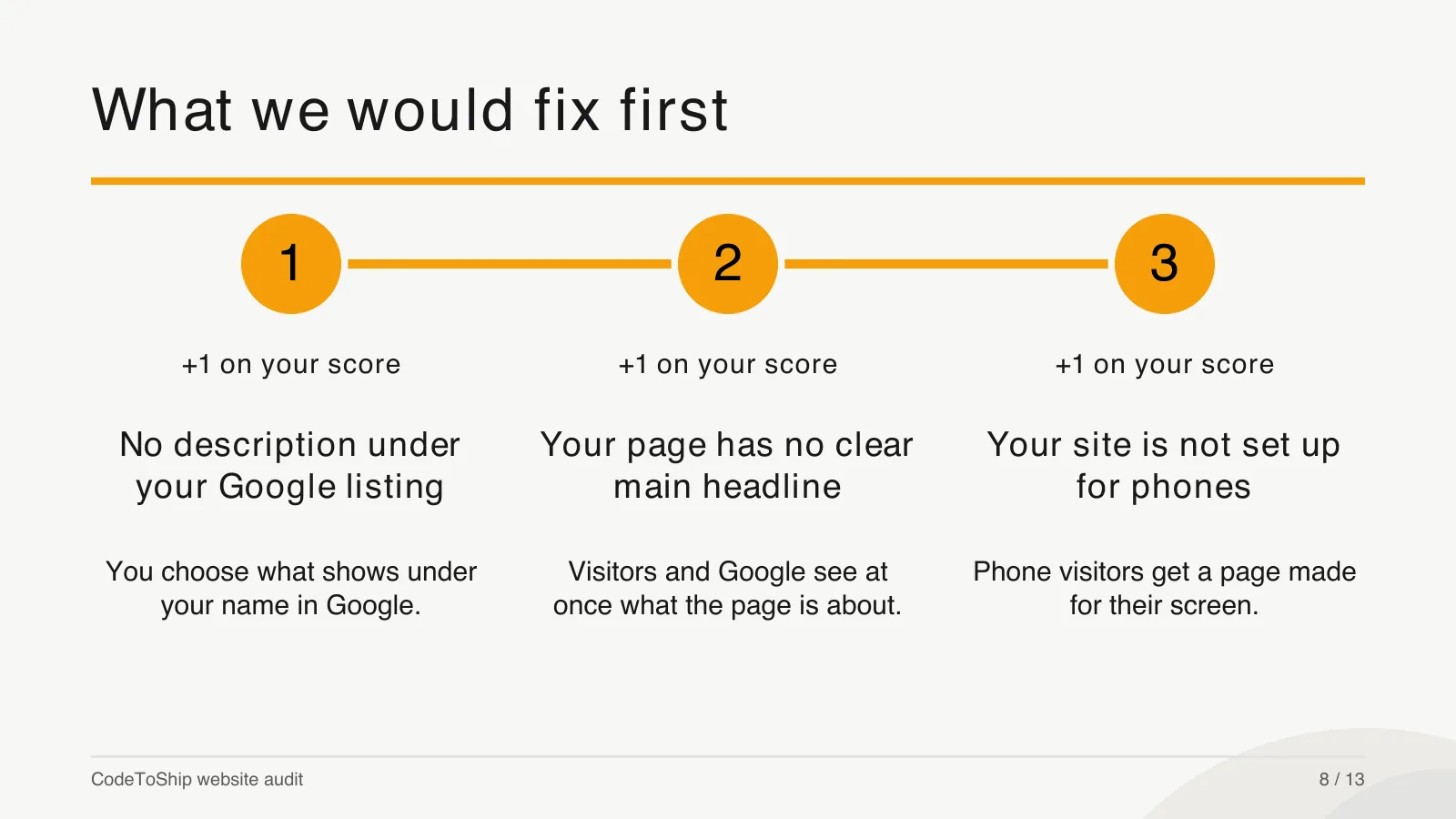
When the owner writes back, do not send a quote yet. Send a short pitch deck made from the same audit. It shows where the site stands, what you would fix and what it could do for the score.
Keep it to a few slides. The score is an estimate, never a promise of more visitors or more sales.
Fix it, and prove it worked
You get: proof, before and after
When they say yes, fix the one thing you promised, then run the audit again. Before and after is the proof. Here it is on a demo page we built for our video: a made-up bakery, not a client. It took three small fixes to take the main picture from 10.22 seconds to 1.61.
A demo bakery page on a phone, slow connection
- Before10.22 s until the main picture shows. Page jump: 0.48The pictures are the size they came off the camera, with no width or height set, and the main picture is set to load late.
- Fix 11.66 s until the main picture shows. Page jump: 0.37Every picture resized to the size it is shown at and saved in a lighter format. The main picture went from 862 KB to 102 KB.
- Fix 21.66 s until the main picture shows. Page jump: 0A width and a height on every picture, so the page keeps the space and the text stops jumping.
- Fix 31.61 s until the main picture shows. Page jump: 0The main picture is told to load first, and no longer set to load late.
Google asks for 2.5 seconds or less to show the main picture, and a page jump of 0.1 or less.
How we measured: a phone-sized screen, a slow 4G connection and a slowed processor, five runs of each version, the middle value shown. It is one demo page, not a promise that every site gains the same.
Send a report with your name, every month
You get: a reason for them to stay
A fixed site does not stay fixed. A new photo is uploaded too big, a plugin changes, a page gets slow. Run the audit again each month and send the owner the report: the score, what you fixed and what is next. Put your own logo, colors and name on it, so the client sees you.
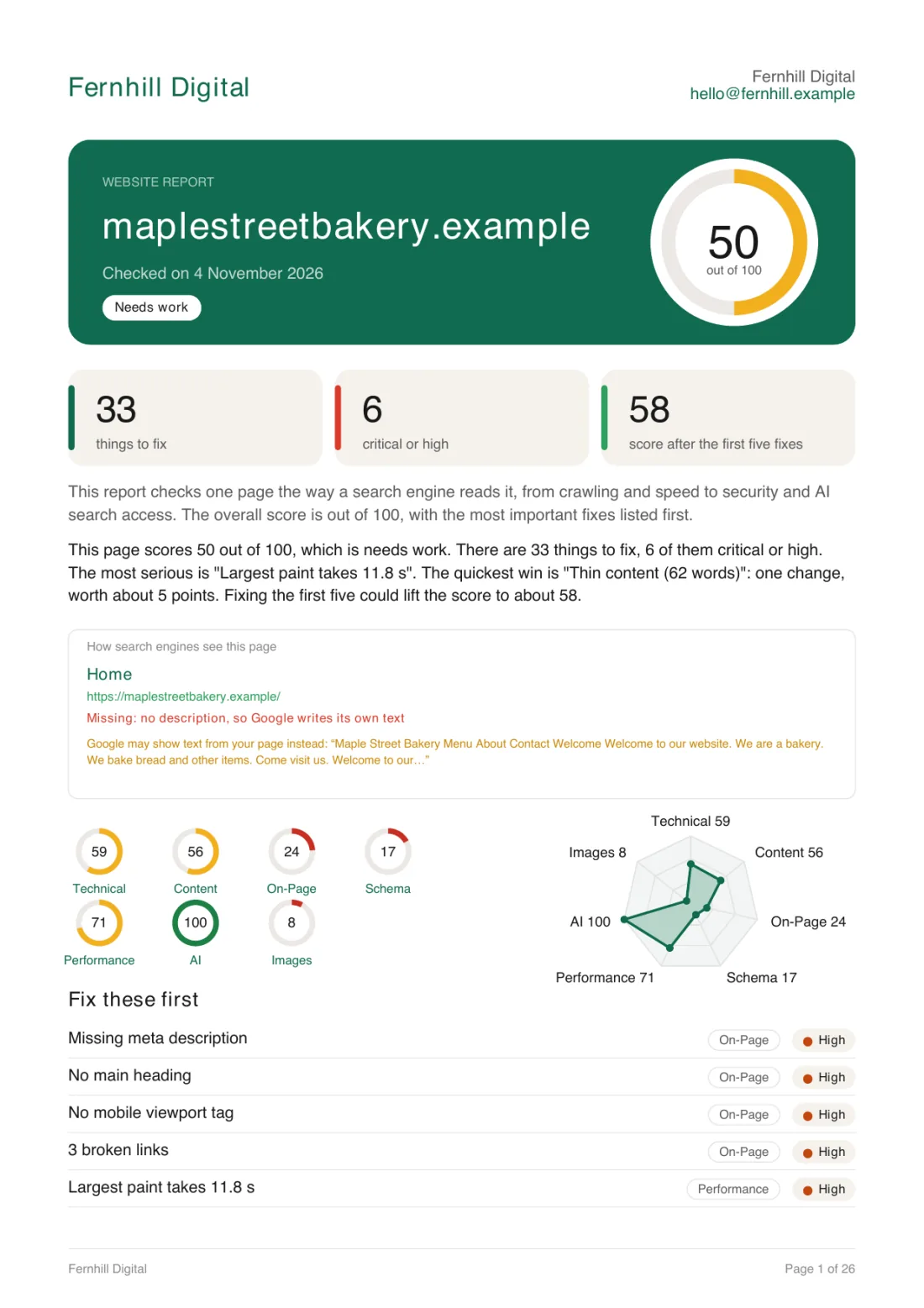
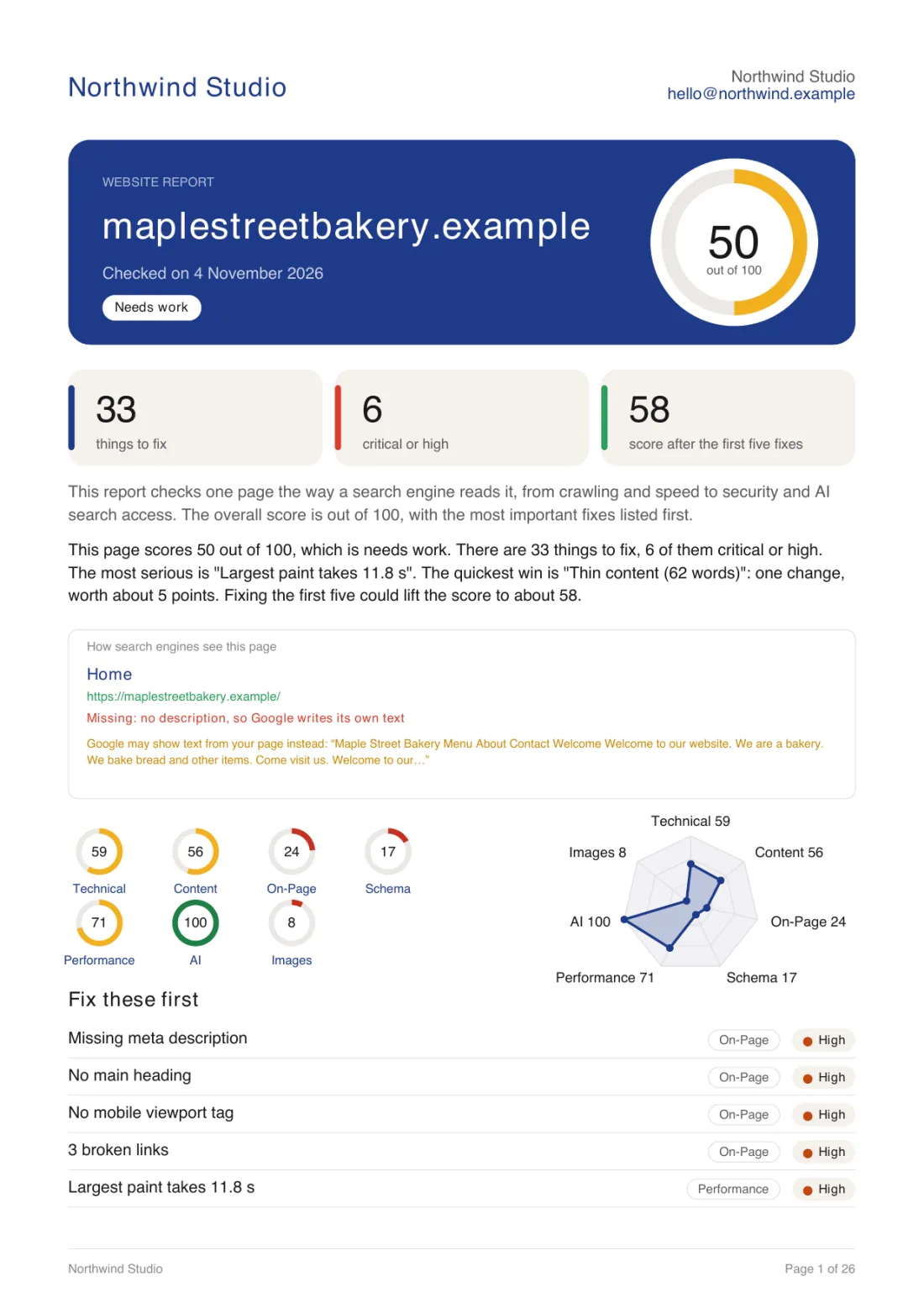
The white label SEO report guide shows what goes on it, and the website maintenance packages guide shows the five parts of a monthly plan. We give no price here, because yours depends on your costs.
Download the real files
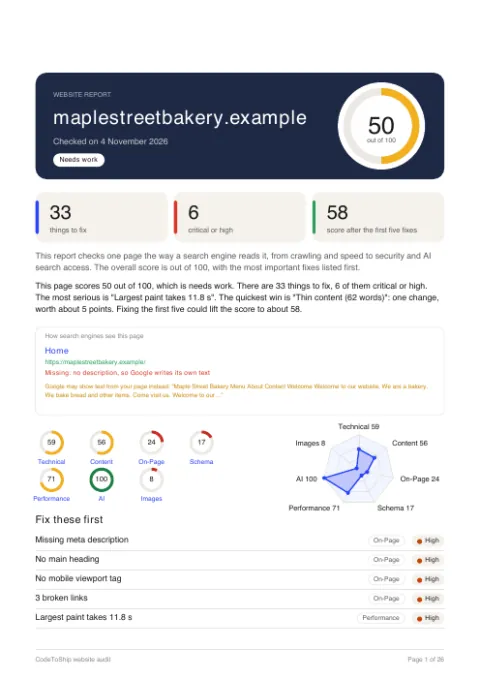
See what you would send before you send anything. These are the product's own designs, as PDFs, made from a real audit of a made-up bakery site with a low score, the kind of site you will find. Free, no sign-up. They are for looking at, not for editing. To build your own, see the SEO audit report template guide.
Reports (what you send)
Pitch decks (what you show)
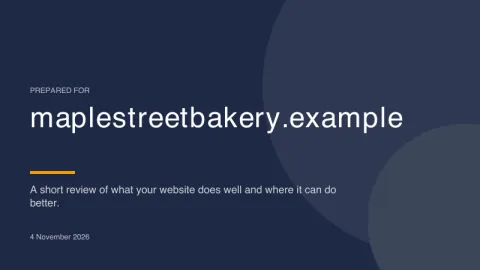 Classic deck13 slides, PDF. Every finding in its own card on a clean page. Familiar and safe.
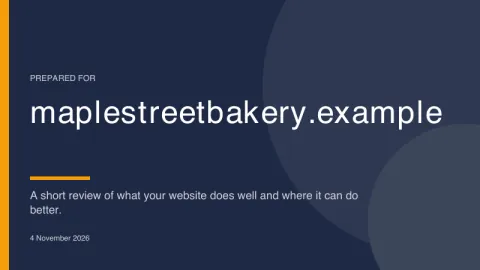 Bold deck14 slides, PDF. One big idea on each slide, in large type. Fewer words, more punch.
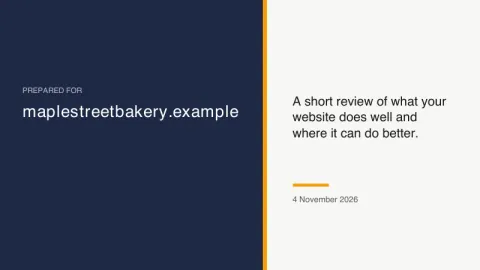 Story deck12 slides, PDF. A colored panel beside the content, and the plan as a timeline.
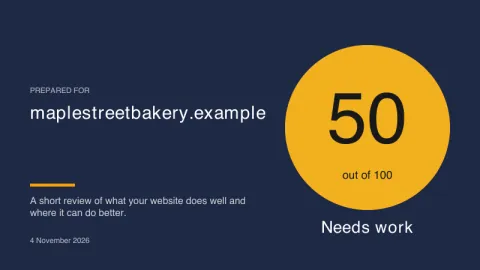 Dashboard deck12 slides, PDF. Rings, bars and a table of findings.
Want a closer look at each design? See all seven on the audit templates page.
Your first week, day by day
Reading will not get you a client. Sending will. Here is one week that takes you from nothing to five messages out the door. Replies are not in your hands, but sending is.
- Day 1Pick five open businesses and score their sites with the six signs.
- Day 2Run the free audit on each one. Write down the easiest finding for each.
- Day 3Write the four-line message for each business. Replace the example numbers with theirs.
- Day 4Send the five messages, one by one. Do not paste the same one five times.
- Day 5Make the pitch deck for anyone who replied, and set a reminder for one follow-up next week.
Questions about getting web design clients
Can I do this with no portfolio?
Yes. The first message is about their site, not yours. Your fix on one real site becomes the first thing in your portfolio.
How many businesses should I message?
Start with five. Spend your time on a good finding for each one, not on a long list. Nobody can promise how many will reply.
What if they do not reply?
Send one short follow-up a week later, with a second finding. After that, move on and keep the audit for your own notes.
Is this cold email?
Yes, a short one. What makes it different is that it opens with one real finding about their own site, so the owner learns something in the first line. Send it to a handful of businesses, one at a time.
Do I need to be an SEO expert?
No. Pick the finding that is easiest to see and to fix, such as a slow picture. The audit tells you what to change, and the checklist guide shows how to check it by hand.
Your first finding is one free audit away
Paste the address of one business you picked. The free audit gives you the score and the first fixes, and you can use them in your message.
Sources and how the examples were made (status checked November 4, 2026)
- The audit is our own audit engine run on a careless demo site for a made-up bakery, on November 4, 2026. The speed numbers come from Lighthouse 12.8.2 run on our own computer, because Google's PageSpeed Insights cannot reach a private page. Only the address was changed afterward, to maplestreetbakery.example. The score, the findings and the PDFs are made from that result.
- The bakery page is a demo made for our video. Times are the middle of five runs recorded on November 3, 2026, on an emulated phone screen, slow 4G and a slowed processor.
- The 2.5 second and 0.1 limits are Google's own thresholds for a good Core Web Vitals score (web.dev, read November 4, 2026).
- The six signs, the four-line message and the five steps are our own advice, not a standard. We cannot promise a reply or a result.