Crawled, Currently Not Indexed: Does It Matter and What to Check
 By Prabhav Lamichhane7 min readPublished · Last checked
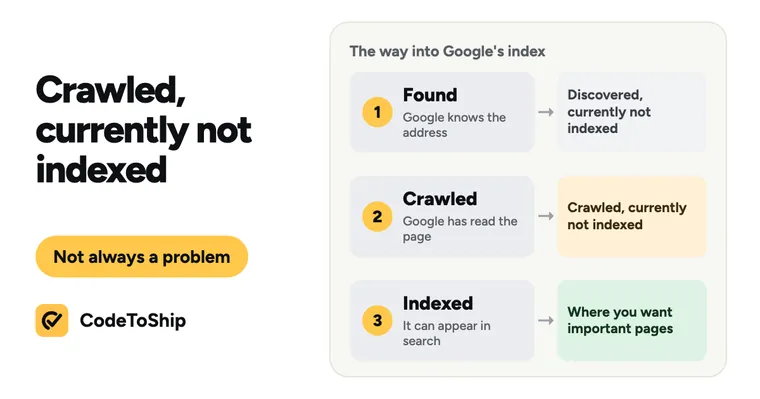
Google read the page but has not added it to its index, for now.
- That does not necessarily mean something needs attention
- It matters when you want people to find the page
To see what the page itself looks like to a crawler, you can run the free audit on it. It checks the page, not Search Console, and the free report lists the first three fixes.
Where this status sits
A page goes through three stages. The two "currently not indexed" statuses sound alike, but they stop at different places.
1. Found
Google knows the address exists.
Discovered, currently not indexed
Found, not read yet. Google says it usually wanted to crawl it, but expected that to overload the site.
2. Crawled
Google has read the page.
Crawled, currently not indexed
Read, not added. This guide.
3. Indexed
The page can appear in search.
Where you want important pages
Does it matter for this page?
Is this a page you want people to find through search?
Leave it. Google says not to expect every address on your site to be indexed.
Is the page new?
Is the page only a few days old?
Work through the triage order below.
Wait. Google says it can take a week or so, and indexing is never instant.
The triage order for an older important page
Google does not publish a list of causes for this status. The steps below are in the order we would check them, and each says whether it comes from Google or is our advice.
Inspect the URL. Google says to use the URL Inspection tool and other tools to diagnose it for important pages. Start there to see what Google last saw.
From Google
Ask if the page has enough of its own text. Our audit flags a page with fewer than 150 words as thin. That is our rule, not Google's. A page that says almost nothing is a weak page to put in search.
Our advice
Ask if it adds anything the other pages do not. Google's own questions are whether the content gives original information and substantial value compared with other pages in search results. Ask both honestly of this page.
From Google
Link to it from a page that is already indexed. Add a link to it from a page that is already in search. It is a cheap thing to rule out.
Our advice
Rule out a site that answers every address. If a made-up address on your site shows a normal page instead of "not found", the index can fill up with empty pages. The audit checks this.
Our advice
Then wait. Google says indexing is never instant, even when you ask for it, and that it does not guarantee every page gets indexed. Do not promise a client a date.
From Google
Check your own page first
Two tools answer two different questions. The status comes from Search Console. The page side comes from looking at the page.
What the audit can see
On one page
- How much text the page has
- Whether the site answers properly for addresses that do not exist
- Whether the page asks to stay out of search
- Whether its preferred address is sound
What only Search Console shows
The URL Inspection tool
- The status itself and when Google last crawled
- Which address Google selected
- Whether the page is on Google
Run the free audit on the page to check these. The free report lists the first three fixes.
A real run: what the audit finds on the page
We ran our own audit on the page of a made-up plumber, Calder Plumbing, three times: as it was, with its text cut to 68 words, and with a server that answers every address with a normal page. The text is what the audit printed. It was one page, with no speed test. The free audit shows less: the score, the grade and the first three fixes.
Run 1
The page: as built, with its normal text
No finding on text or missing pages. The audit passes both.
Score 78 out of 100
Run 2
The page: text cut to 68 words
Thin content (68 words) (Medium). A page with fewer than 150 words rarely gives search engines enough to understand what it is about.
Score 71 out of 100
Run 3
The page: the server shows a normal page for any address
Pages that do not exist look like real pages (Medium). Search engines then treat every mistyped or deleted address as a real page.
Score 77 out of 100
Cutting the text moved the score by seven points, the most of the three. That is how the audit weighs a thin page. Run 3 also showed three low findings about a favicon and links, which appear because the test server answers every address with the page. Google does not say either of these causes this status. They are the page-side things the audit can rule out.
What to tell the client
Clients see "not indexed" and think the page is broken. Two short messages, one for each case. Neither promises a result.
When the page is not one you need in search
"Search Console lists some addresses as crawled but not indexed. Google says not every address on a site gets indexed, and these are not pages we need people to find, so no change is needed."
When it is an important page
"Google has read this page but has not added it to search yet. We checked the page: we are adding more of its own content and linking to it from the home page. We will check again in a few weeks."
Questions about this status
Is "crawled, currently not indexed" an error?
Google does not call it one. Its Page indexing report help says the status "doesn't necessarily indicate an issue that needs attention". It matters for pages you want people to find.
How long should I wait before worrying?
Google says it can take a week or so for a new page or site to be crawled and indexed, and that indexing is never instant, even when you request it. For an older page, work through the triage order instead of waiting.
Will asking Google to index the page again fix it?
Not by itself. Google says that even when you submit a crawl request directly, indexing is not instant, and that it does not guarantee every page will make it into the index. Fix what the triage finds first.
Does the free audit show this status?
No. Search Console shows it, and our audit does not read Search Console. The audit checks the page side on one page: how much text it has, whether the site answers properly for addresses that do not exist, and whether the page asks to stay out of search. The free report lists only the first three fixes.
How this check works, and what it cannot see
- The audit reads one page: how much text it has, whether the site answers properly for an address that does not exist, whether the page asks to stay out of search and whether its preferred address is sound.
- It does not read Search Console, so it cannot show this status, when Google last crawled the page or why it was left out.
- It does not compare the page with other pages on your site or in search, so it cannot tell you the page is a near copy.
- The free audit shows the score, the grade and the first three fixes, and runs no speed test. The runs above show the full audit's output.
- The plumber's page is made up, and the runs were on our own computer. Your site will have different findings.
Rule out the page side in a minute
Paste the address of an affected page into the free audit. For the wider set of checks, see the technical SEO audit checklist. If the status shows up after a new design, see the website redesign SEO checklist. For a look-alike status, see duplicate without user-selected canonical. If your whole site is missing from Google, start with website not showing on Google.
Sources and when they were read
- Search Console Help, Page indexing report (read November 5, 2026): the two statuses, the timing and that not every page is indexed.
- Google Search Central, Creating helpful, reliable, people-first content (read November 5, 2026): the questions about original information and substantial value. The page does not mention indexing.
- The three audit runs are our own audit engine on a page we built, run on November 5, 2026. The findings and scores are its output. The 150-word rule is ours.
- The plumber is made up.