Local SEO Audit Checklist: What 82 Real Local Business Websites Missed
 By Prabhav Lamichhane11 min readPublished · Last checked
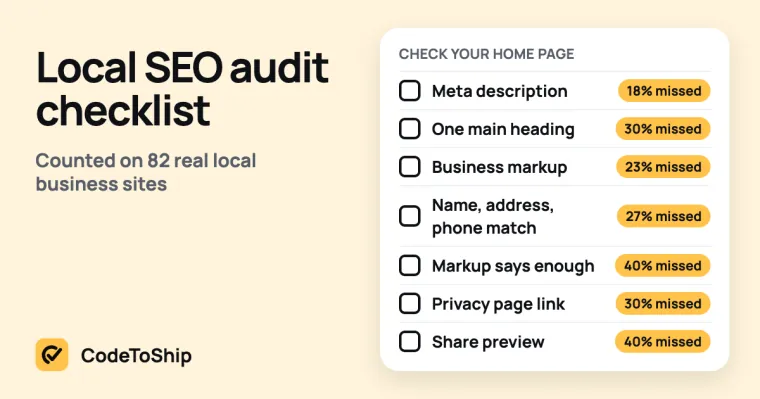
A local business can look fine and still tell Google very little about itself.
- 15 of 82 had no meta description
- 19 had no business markup at all
- 22 had markup that disagrees with the page
- Average score 79.4 out of 100
We ran our audit on the home pages of 82 local business websites to see how often that happens. Here is the checklist, in the order we would fix it.
To run these checks on your own site, you can run the free audit. The free report lists the first three fixes.
What this checklist covers, and what it does not
It covers your website: the page, what Google can read from it, and your business details on it.
It does not cover your Google Business Profile, your reviews or your listings on other sites. We did not check those, and our audit does not read them.
The short answer
The sites were dentists, lawyers, roofers, plumbers, HVAC firms, contractors, real estate agents and restaurants. Scores ran from 49 to 90, with a median of 81.
58 of 82 had at least one high-severity finding. The high ones were basics a site owner can fix in minutes: no meta description, no main heading, and broken links, which our agency study covers.
The checklist, in the order to fix it
Write a meta description
15 of 82 sites (18%)
Nearly one in five local sites wrote nothing for the line under their name in search results. Without it, that line can read like a menu: Home, About, Services, Contact. 15 of the 82 had no meta description, and 16 more had one outside 50 to 160 characters (our rule). Of the 80 agency sites we audited, one had none.
Fix it: Write 50 to 160 characters: what you do, where, and why to call. In WordPress, use the description field in Yoast SEO or Rank Math. On Shopify it is Search engine listing, and in Wix and Squarespace it is the page's SEO settings. Google may still write its own line. It says it uses yours when yours describes the page better.
What the check does: it decides who writes the sentence under your name No meta description
riversidedental.example
Riverside Dental
Home About Services Meet the team Contact Book online Menu Skip to content Call us today Opening hours Monday
A line picked from the menu
A written description
riversidedental.example
Riverside Dental
Family dentist in Leeds. Check-ups, fillings and emergency appointments. New patients welcome, book online or call.
A sentence you wrote
A made-up business. Google says it mainly uses the content on the page to decide the snippet, and may use your description when it describes the page better. A good one gives it a better choice.
Give the page one main heading
25 of 82 sites (30%)
A page with no H1 never says what it is about. Think of it as the sign on the door. 12 of the 82 had none, and 25 had none or several.
Fix it: Pick the line at the top that says what the page is about, such as "Emergency plumber in Bristol", and make it the only H1. In your page editor, choose Heading 1 for it and Heading 2 for the section titles.
What the check does: it says what the page is about, in one line No H1
- H2Our services
- H2Areas we cover
- H2Contact
Nothing says what the page is
One H1
- H1Emergency plumber in Bristol
- H2Our services
- H2Areas we cover
- H2Contact
The topic is one line
A made-up business. The audit counts the H1 elements in the page: none is a high finding, and several is a medium one.
Add business markup
19 of 82 sites (23%)
Markup is the part of the page written for machines: your name, address, phone and hours, in a form Google can read. 19 sites had none, and 10 had a block the audit could not read at all. Google does not promise it will use markup, and says the more properties you give, the higher the quality of the result.
Fix it: Add a LocalBusiness block (JSON-LD) to the home page with your name, address, phone and hours. Google's local business page shows the format.
What the checks do: they give Google the business details in a form it can read No business markup
hartleyco.example
Hartley & Co. Solicitors
Solicitors for families and small businesses.
Google has to guess the details
Complete business markup
hartleyco.example
Hartley & Co. Solicitors
Solicitors for families and small businesses.Open Mon to Fri, 9 to 5 · 0113 496 0100 · 12 King Street, Leeds
Hours, phone and address are readable
A made-up business, drawn to show what the markup is for. Google says it does not guarantee that features that use structured data will show up, and that the more properties you give, the higher the quality of the result.
Make the name, address and phone in the markup match the page
22 of 82 sites (27%)
This is the "NAP consistency" people search for, on your own site. On 22 sites the markup said one thing and the page said another: a phone number that is not on the page, a street that is not the address shown, or a business name the page never uses. When the two disagree, search engines are less sure which one is right.
Fix it: Copy your name, address and phone exactly as they are on your Google Business Profile. Put the same words in the footer and on the contact page, then make the markup match. Check "Street" against "St", and the country code on the number.
What the check does: it compares what the page says with what the markup says On the pageIn the markupPhone0113 496 01000113 496 0199DifferentStreet12 King Street12 King StSameA made-up business. The audit compares the phone by its last nine digits, the street with common abbreviations spelled out, and the name ignoring capitals and punctuation.
Say enough in the markup
33 of 82 sites (40%)
Google's local business page lists the address as required. Many sites gave little more than that. 33 left out details Google recommends, such as opening hours, a phone number, coordinates, a price range or an image. 9 used a general business type where a more specific one exists.
Fix it: Add opening hours, telephone, url and image. Give geo as latitude and longitude with five decimal places, and priceRange in under 100 characters, such as $$. Add review or aggregateRating only if the reviews are real and shown on the page.
Link to a privacy page and a contact page
25 of 82 sites (30%)
Visitors and search engines look for these pages when they decide whether a business can be trusted. 25 of the 82 home pages did not link to a privacy page.
Fix it: Add "Privacy Policy" and "Contact" links to the footer so they show on every page. In WordPress, add them under Appearance, then Menus, then a footer menu.
Make sure http:// goes to https://, and the page works on a phone
4 of 82 sites (5%)
4 sites did not send the http:// address to https://, and 5 had no mobile viewport tag, the line that tells a phone how to show the page. Both are quick fixes.
Fix it: Turn on a redirect from http:// to https:// at your host. In Cloudflare, it is Always Use HTTPS. Add
<meta name="viewport" content="width=device-width, initial-scale=1">to the page's head.Set a preferred address and a complete share preview
33 of 82 sites (40%)
When someone shares your page in a chat, the preview is built from a few tags. 33 sites had an incomplete one, and 9 did not name a preferred address for the page.
Fix it: Add the title, description and image tags that apps read for previews, and a canonical link that names the page's own address. The free audit lists which ones are missing.
To check your own page by hand, open its source and look for a meta description, one h1 and a LocalBusiness block. Or run the free audit, which reports each of these.
Also common, and covered elsewhere
Three more findings were common on these sites: images with no width and height (50 of 82), a broken link on the home page (22), and security headers (74 set no limits on browser features). We expected the headers to be the story. They were the most common finding, and the least useful one for a local business.
Agency sites have the same three, and we explain each one, with pictures and fixes, in the study of 80 agency websites. You can check your own headers with the security headers checker.
The eight checks at a glance
- 1. No meta description18% (15 of 82)
- 2. No single main heading30% (25 of 82)
- 3. No business markup23% (19 of 82)
- 4. Markup the audit could not read12% (10 of 82)
- 5. Markup disagrees with the page27% (22 of 82)
- 6. Markup leaves out details40% (33 of 82)
- 7. No link to a privacy page30% (25 of 82)
- 8. Incomplete share preview40% (33 of 82)
What this means for your site
- Write a meta description for your home page today. It takes five minutes.
- Check that the page has one H1 that says what you do and where.
- Add LocalBusiness markup, and make its name, address and phone match the page.
- Add Privacy Policy and Contact links to the footer.
- Leave images, security headers and links until these are done.
None of this promises a ranking. It fixes things Google can see on the page.
By trade: a rough picture, not a ranking
Average score of the audited sites of each trade. Each trade has 8 to 12 sites, so a difference of a few points is noise.
| Trade | Sites audited | Average score |
|---|---|---|
| Roofers | 11 | 84.1 |
| Plumbers | 8 | 82.2 |
| Lawyers | 8 | 81.4 |
| Dentists | 11 | 78.6 |
| Contractors | 11 | 78.5 |
| Real estate agents | 11 | 78.3 |
| HVAC | 12 | 77.2 |
| Restaurants | 10 | 76.5 |
How we picked the sites, and what this cannot show
- We drew 118 sites at random from businesses listed in OpenStreetMap with a website, across 14 city areas in the US, UK, Canada, Australia and Ireland, and 82 could be audited. They are not all businesses, and not the ones that rank.
- Our audit read one page per site, the home page, without Google's speed test, one request at a time with a gap between sites. It respects robots.txt, and it skipped the sites that block auditing tools.
- We opened 10 of the audited sites by hand and compared six findings each: 57 of 60 comparisons matched. The three differences were borderline cases counted differently.
- We could not tell which website builders the sites use. No site is named.
- It shows what was on home pages that day. It does not show where any site ranks, or what a fix would earn.
| The site blocks auditing tools in robots.txt | 10 |
| The address was not found | 10 |
| The site's firewall turned us away | 8 |
| The page failed to load | 6 |
| Another error | 2 |
Our earlier study of 80 agency websites was picked differently, so the two are not a controlled comparison.
Questions about local SEO audits
What is a local SEO audit?
A check of what makes a local business easy to find and trust: its website, its Google Business Profile, its reviews and its listings on other sites. This guide covers the website part.
Is there a free local SEO audit tool?
The free audit on this site checks the website part: the page, its markup and your business details on it. It does not read your Google Business Profile or your reviews.
How long until a fix shows in search?
Google says crawling can take a few days to a few weeks, and that nothing guarantees a page will be included. See why a website is not showing on Google.
Does every local business need structured data?
No. Google describes local business markup as a way to help it understand and show your business details, and says it does not guarantee that features that use it will show up.
Is this a study of all local businesses?
No. It is businesses listed in OpenStreetMap with a website, drawn at random, and 82 of them could be audited. See how we picked them below.
Run these checks on your site, or a client's
Paste an address into the free audit. For the wider set of checks, see the website audit checklist. If your site is not in Google yet, start with website not showing on Google. For a report to send a client, see the SEO audit report template.
Sources and when they were read
- Google Search Central, Control your snippets in search results (read November 16, 2026): Google mainly uses the page content for the snippet and may use the meta description when it describes the page better.
- Google Search Central, Local business structured data (read November 16, 2026): the address is required, more properties give a higher quality result, and features are not guaranteed.
- The numbers about the sites are our own audit engine on the home pages, run on November 16, 2026. The 50 to 160 character rule and the severity labels are ours.
- All the businesses drawn in the pictures are made up.